Which food processing grant to choose for your project?
Start from your project, whether equipment, recipe, standards, campaign or export, to find out which food processing grant to apply for in 2026.
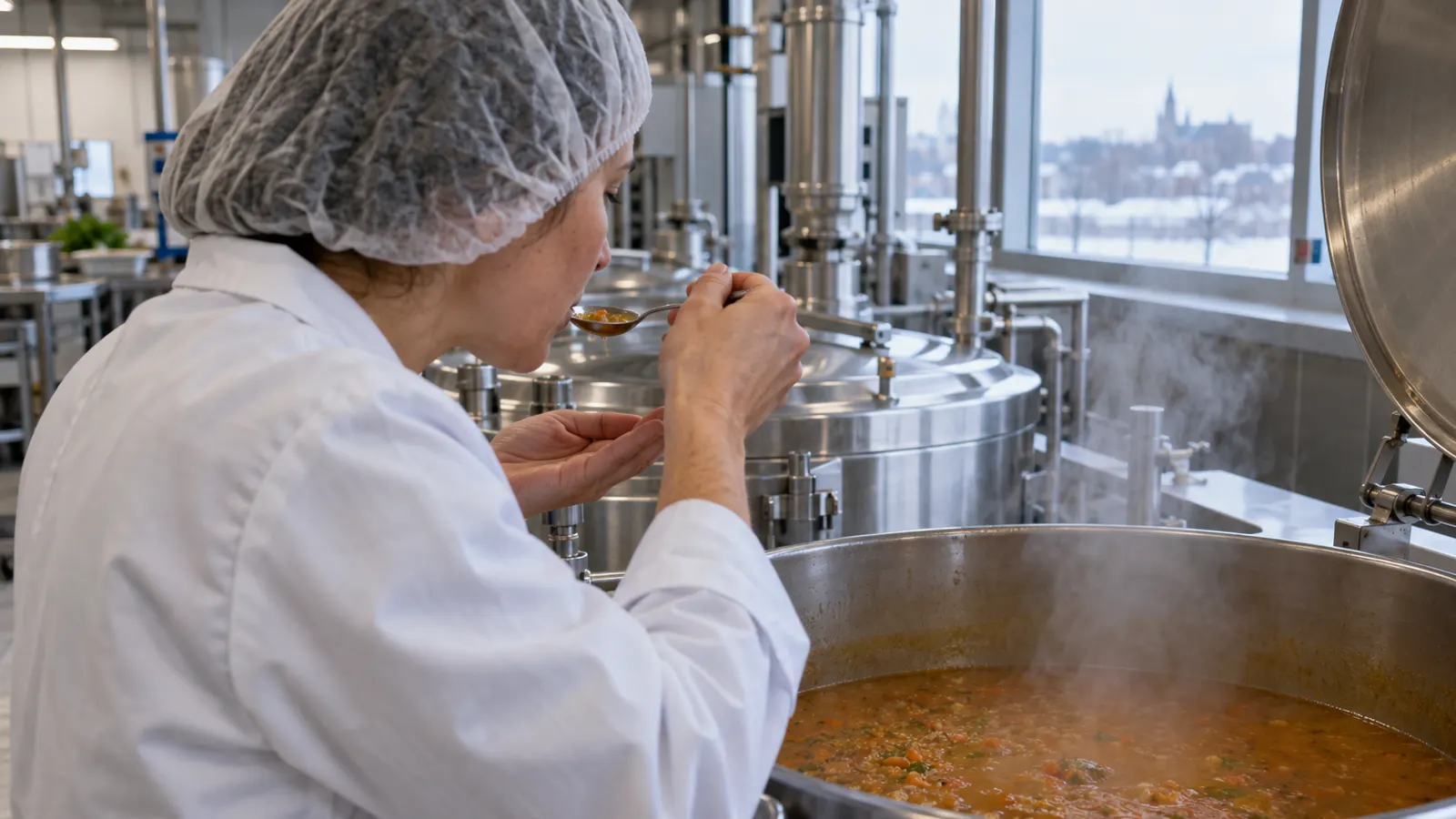
Key takeaway: To find out which food processing grant to apply for, first classify the project. In fall 2026, a recipe or a new food product leads to the Healthy Eating Program, open until 2029. Equipment or compliance upgrades wait for the PTA, which is closed. A collective campaign goes through the PADAAR, and exporting through AgriMarketing.
The program name is the last thing to choose when you are looking for which grant to apply for on a food processing project. A processor rarely shows up with an acronym in mind. It shows up with a quote for a bagging machine, a soup that is too salty, an audit required by a grocery chain or an order from a distributor abroad.
These four files do not go to the same window, and two of them have no open window at all this fall. Start by naming what the money will pay for: the program follows from that.
Five projects lead to five different doors
In brief: The nature of the expense points to the program, and the program’s status tells you whether to apply right away, wait for a reopening or team up with others.
Find the row that describes your project, then read the status before anything else:
| Your project | Program that funds it | Status as of October 26, 2026 | What to prepare right now |
|---|---|---|---|
| Automating a line, installing a robot or an enterprise management software package | PTA, stream 2 | Closed since August 10, 2026 | Productivity diagnostic and financial simulator score |
| Bringing the plant up to standards: HACCP, preventive control plan, certification | PTA, stream 3 | Closed since August 10, 2026 | Written requirement from the customer or the target market |
| Creating a food product or reformulating a recipe | PAS, streams 1 and 2 | Continuous intake until March 31, 2029 | Current label and an external consultant’s offer |
| Promoting regional products together with others | PADAAR, measure 4021 | Open until February 15, 2027, application submitted by an organization | Two other partner businesses |
| Selling outside Quebec or abroad | AgriMarketing, SME stream (federal) | Open until September 30, 2030 | Target market and a budget of at least $20,000 |
At MAPAQ, only the “Creating a food product or reformulating a recipe” row currently accepts an application from a company applying on its own. For each program’s details, stream by stream, the comparison of the PTA, PADAAR and PAS covers them all.
A new food product or a lighter recipe leads to the Healthy Eating Program
In brief: The PAS pays for work on the product, provided the target food drops below 15% of the daily value in sodium, sugars, and saturated and trans fats.
Under the Healthy Eating Program, stream 1 covers 70% of a diagnostic study, up to $100,000, provided an external consultant carries it out. Stream 2 then takes over to develop the recipe or the new food product.
According to the stream 2 applicant’s guide, this second stream reimburses up to 60% of expenditures, with a maximum of $150,000 and a minimum project of $10,000. Certain priorities, including sodium in deli meats and sauces, can be worth an extra 10%, with no guarantee.
The test is done with the package in hand. On the nutrition facts table, the percent daily value for sodium, sugars, and saturated and trans fats must fall below 15%. A soup with 690 mg of sodium per 250 ml serving shows 30%: more than half of the salt has to go.
For this soup, a $28,000 diagnostic study brings in $19,600 under stream 1. The development that follows, costed at $120,000 across trials, analyses, shelf life and packaging, brings in $72,000. These amounts are illustrative only: the department also reviews seven indicators drawn from the financial statements.
Two cases remain out. A beer or an alcoholic ready-to-drink beverage is not a food within the meaning of the program. A restaurant that lightens its dishes is not doing food processing, even with the best recipe.
Before ordering the first trials, have your recipe’s eligibility confirmed, along with the stream to start with.
Equipment or a compliance upgrade gets prepared while the PTA is closed
In brief: Automation and food safety fall under the PTA, none of whose streams accepts applications, and the PAS funds a machine only if it controls the quality of the new food product.
According to the official Food Processing Program page, the envelope is exhausted: streams 1 to 3 have been closed since August 10, 2026, and stream 4 since August 14 at 4 p.m.
The conditions of the last edition still serve as a working checklist for the reopening:
- Automation (stream 2): at least $50,000 in expenditures, a productivity gain demonstrated by a diagnostic, $300,000 in processing revenue and $100,000 in equity.
- Compliance upgrades (stream 3): at least $15,000 in expenditures for a quality management system, a preventive control plan, a recognized certification or a foreign market requirement that differs from Canadian rules.
- Financial health (all streams): the same page states that financial criteria were the leading reason for ineligibility at the 2025 launch, and that a result of 1.29 or lower on the simulator leads to an automatic refusal.
Run your latest financial statements through the simulator now. A company below the threshold needs a different financing structure, not just patience.
Slipping a bagging machine into a recipe application does not work either: under the PAS, only a machine used to control the quality of the developed or modified food product is eligible.
A collective project goes through an organization, never a company on its own
In brief: PADAAR measure 4021 funds regional promotion led by a group or a recognized organization, and the processor takes part without signing the application.
Measure 4021, Promotion of Regional Products, supports initiatives that get people to buy more Quebec foods in the regions. Its application comes from a group of farms or an organization recognized by MAPAQ.
According to the official PADAAR page, applications for 2026–2027 are accepted on a continuous basis until February 15, 2027, or until funds are exhausted. The measure’s form requires a collective scope, meaning at least three agri-food businesses reached, and an eligible budget of $2,000 or more.
The useful move: approach your MRC or your regional agri-food round table with two partners and a specific idea. A shared booth at a public market or a week of in-store grocery tastings is enough as a starting point.
Exporting leads to Ottawa rather than to MAPAQ
In brief: To open a market outside Quebec, the SME stream of AgriMarketing, managed by Agriculture and Agri-Food Canada, accepts applications until September 30, 2030.
None of MAPAQ’s three programs pays for a trade mission or a campaign abroad. The Market Diversification for Small and Medium-sized Enterprises stream of AgriMarketing targets for-profit businesses in agriculture and agri-food, fish and seafood included.
The federal contribution covers at most 70% of eligible costs and normally stays under $100,000 per project, over 18 months at most. The project must cost at least $20,000, and the company’s share is paid in cash: time or materials provided in kind do not count.
A sanitary requirement specific to the target country falls instead under stream 3 of the PTA, which is closed. Export assistance outside the agri-food sector is reviewed in the guide to export grants.
Your project tells you which food processing grant to target
Back to the bagging machine, the soup, the audit and the foreign order. The soup can be submitted to the PAS this week. The audit and the bagging machine get prepared for the PTA’s reopening, with the simulator already run. The foreign order heads to AgriMarketing, and the regional campaign gets put together with two neighbours and an organization.
Whatever the door, the date matters as much as the program: under the PAS, an expense incurred before a complete application is filed remains at your expense. Knowing which food processing grant to apply for is no use if the invoice comes before the application. Describe your project to an advisor before signing the first purchase order.
FAQ
Which food processing grant can I apply for while the PTA is closed?
The Healthy Eating Program, if the project involves the food product itself. For anyone wondering which food processing grant to apply for this fall, it is the only one of MAPAQ’s three that still accepts an application from a company on its own, on a continuous basis until March 31, 2029. Count on 70% for the diagnostic study and 60% for the reformulation. Production equipment, for its part, waits for a PTA with no announced return date.
Can the Healthy Eating Program be combined with other public assistance?
Yes, up to a cap. The stream 2 guide limits combined public assistance to 75% of eligible expenditures, and the company must fund at least 20% of them itself. Municipal assistance counts toward that total. On a $120,000 reformulation, a $25,000 municipal grant therefore brings MAPAQ’s maximum assistance down from $72,000 to $65,000, to respect the $90,000 cap.
Does the Healthy Eating Program fund a microbrewery’s beverages?
Not its beers. The guide excludes products containing alcohol or cannabis, as well as energy drinks, natural health products and meal replacements. A non-alcoholic beverage can, however, be developed under stream 2, on one condition: targeting a fibre content of at least 2 g per reference amount, or adding a bioactive compound. A house-made kombucha therefore has a path forward.

Elie Karam
President
Expert in grants and tax credits, Elie Karam has been helping Quebec businesses obtain government funding for over 15 years. His passion for innovation and deep expertise in financial assistance programs make him the ideal advisor to maximize your returns.
More about Elie Karam View LinkedIn profile